I have to admit I was left wanting more after Cacela Velha. Yes, I never made the crossing; I stayed on the shore while everyone else waded across, and so we stopped instead in the town of Tavira.
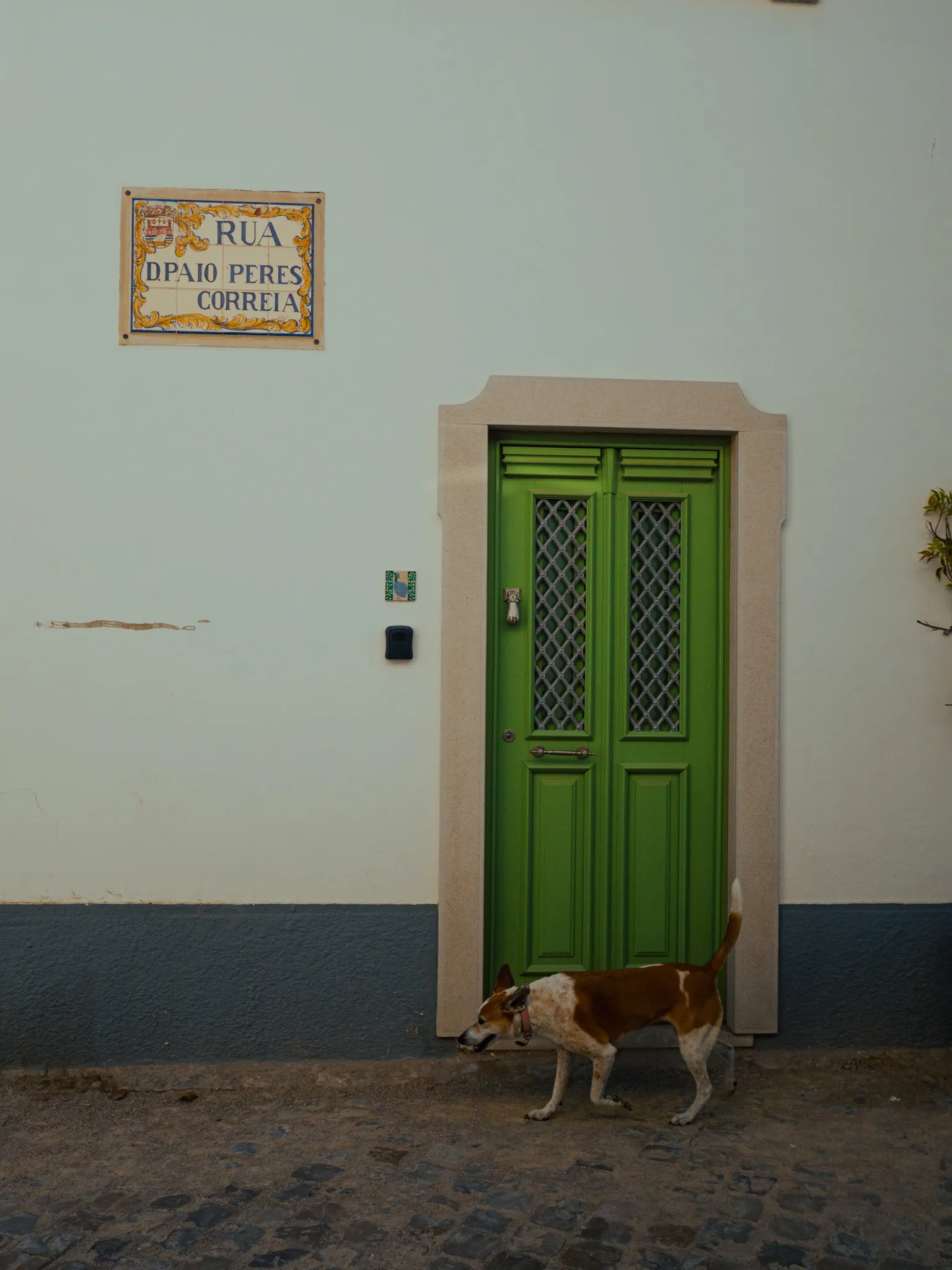
What a beautiful surprise. Tavira is the Algarve people mean when they speak of the "real" Portugal: unhurried, deeply authentic, a tangle of cobbled streets and whitewashed houses, azulejos at every turn, and so many church towers that I began to suspect there were more churches than residents. I later learned the town has thirty-seven of them. A seven-arched Roman bridge crosses the slow Gilão River at its centre, and some people call Tavira the Venice of the Algarve.
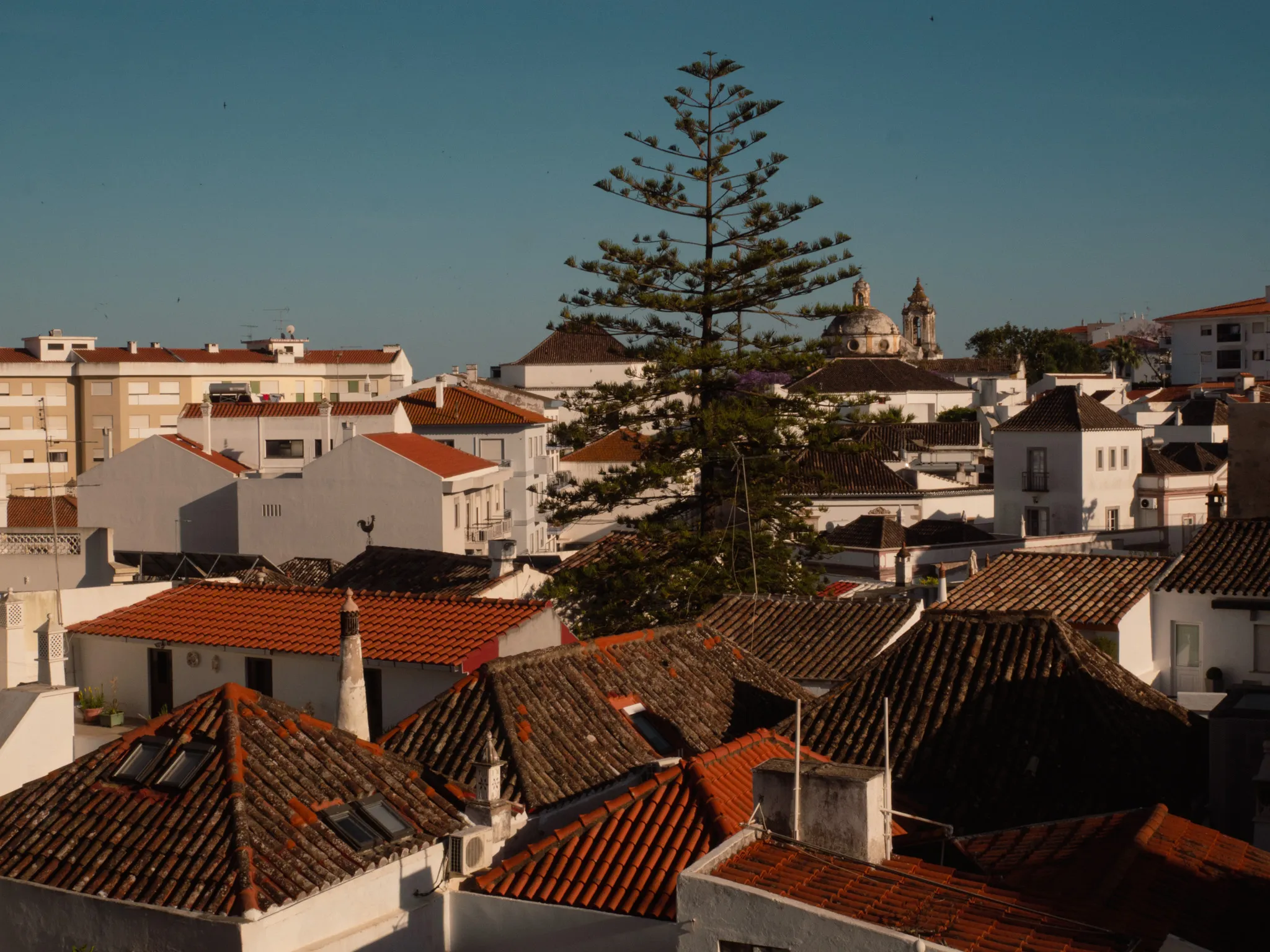
Around six in the evening, I climbed up to the Castelo de Tavira, the old castle that crowns the highest point of the town. Entry is free, and little remains today beyond the outer walls, a few towers, and a quiet garden, but the view from the battlements is reason enough to climb: terracotta rooftops stepping down toward the river, bell towers breaking the skyline, and the lagoon stretching south to the sea.
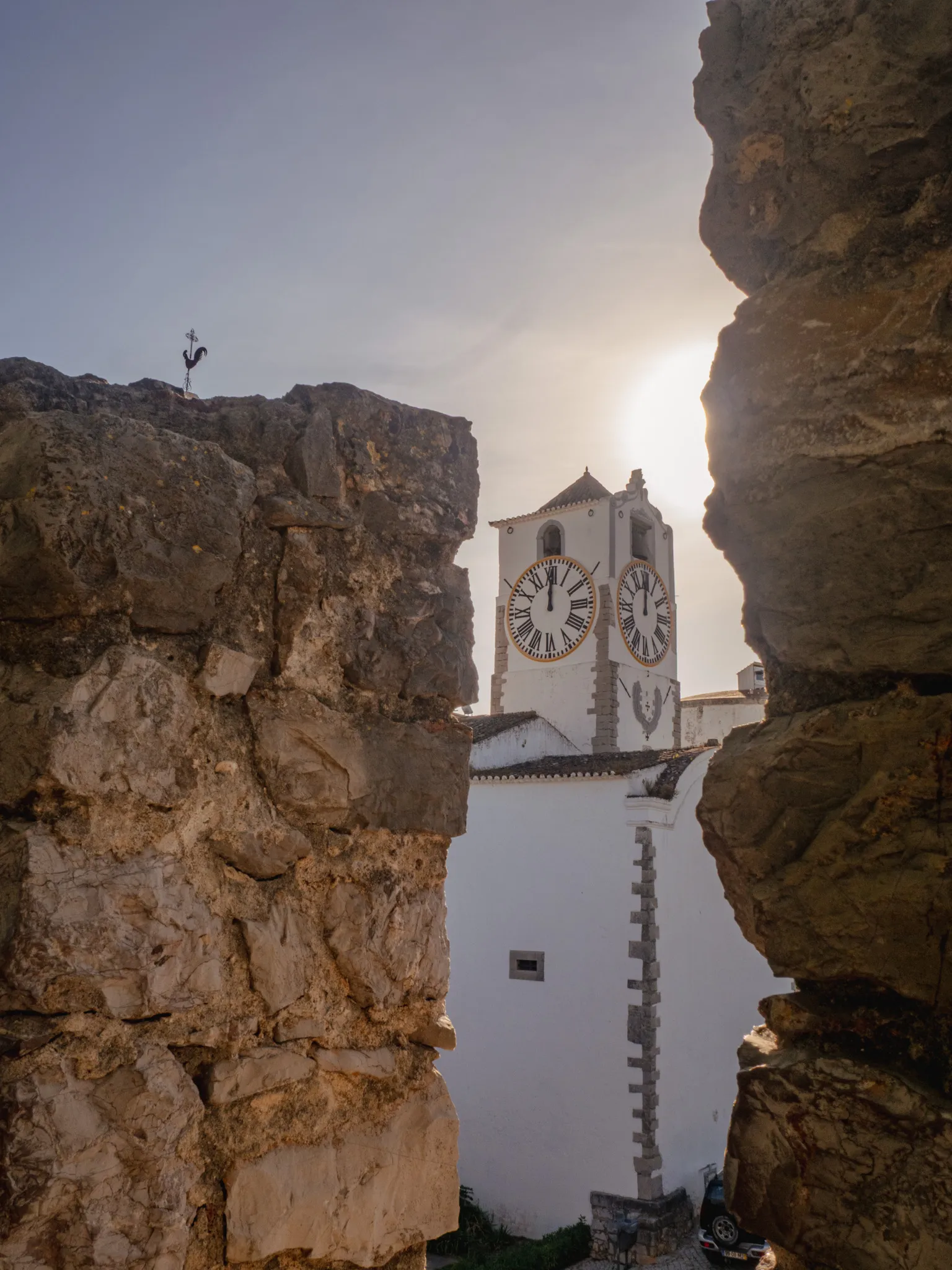
The castle was raised in Moorish times and then largely rebuilt after the Christian reconquest in the thirteenth century. Beside it stands the church of Santa Maria do Castelo, built on the site of what was once a mosque. So for the second time that day, I found myself standing inside something my own ancestors had begun, and history stopped feeling like a chapter in a textbook and started to feel like a conversation.
In the rose garden inside the walls, a group of Portuguese and their teacher were making the strangest sounds. A theatre class, I assumed, until they began to sing, then to laugh, then to lead one another blindfolded through the roses. I watched from the stairs of one of the towers, intrigued, trying to file the scene under some heading: a music class, a theatre class, a class in pure madness. I had not decided when, suddenly, it began to rain.
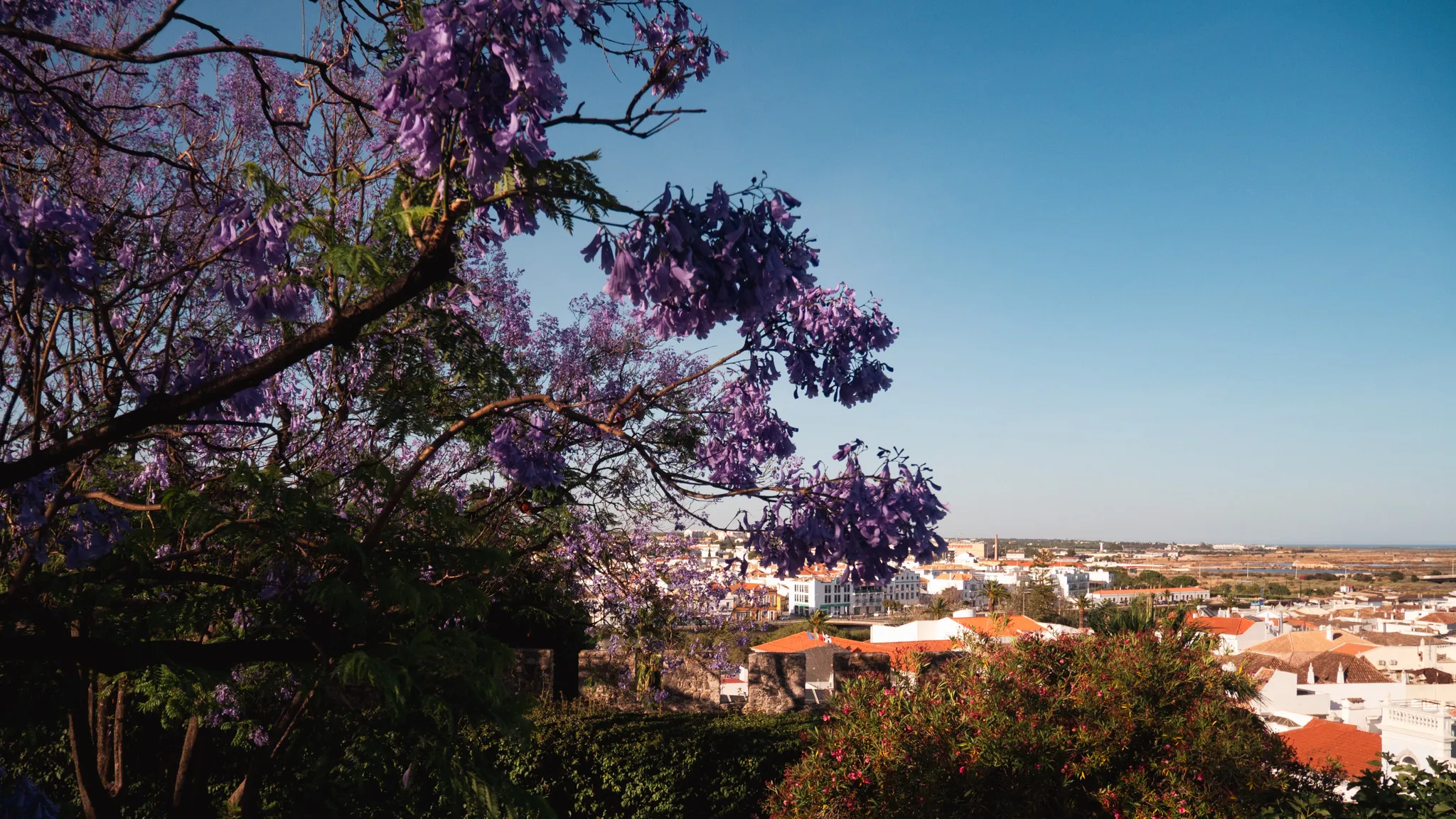
It rained violet flowers. The wind set the trees trembling and the jacarandas let go all at once, and across the square the great cathedral bell began to ring, as if the city had decided this moment was not yet dramatic enough. The white houses turned whiter, the petals fell on my hair, my shoulders, my face, and for once I simply let it happen. I closed my eyes. I thought of nothing, only the wind, and my ancestors, and the colour violet. Perhaps it was a message from them, here, in a castle their own people had built.
I am violet. That is my colour. That is the message.
I had always believed I was blue: the good girl, the careful one, the analytical mind, all plans and reason. The night before, reading Soufi, mon amour, I had begun to wonder whether people have a colour of their own, not the colour they wear, but the colour they are. I even asked my friend what mine was; her answer did not convince me. And then chance carried me to this castle and handed me the answer the wind had been carrying all along. Violet, the colour of dreams, of intuition, of beauty that does not explain itself. The colour of a woman who decided, slowly, to step out of the ordinary: to stop being the velha that Mauritanian society expects, to stop chasing perfection, to belong to no single box.
And perhaps that was the real lesson hiding in the rose garden. I had spent the whole scene trying to name what those people were doing (theatre, music, madness) exactly as I have spent much of my life trying to name myself.
Nietzsche once wrote that every concept is born from the equation of unequal things. In nature there is no such thing as "the leaf," only countless leaves, no two alike, each with its own veins and tears and particular way of curling. The word leaf exists only because we agreed to forget everything that made each one singular. To name a thing, in other words, is already to flatten it. To lose what made it itself.
So why do we insist on naming everything? On filing people into boxes: the obedient daughter, the sensible employee, the perfect Mauritanian woman, the perfect European one?
For most of my life I tried to decide which leaf I was. The Mauritanian one, or the European one. The good daughter, or the woman who hikes alone and comes home with sun on her skin. I thought I had to choose, to belong cleanly to one side or the other, and to apologise for every part of me that spilled over the edges.
But Nietzsche was right. There is no "the leaf." There is only this leaf, and that one, and the next, each of them different, none of them the template, because the template never existed.
So perhaps I do not have to choose. I can be a Mauritanian woman who hikes and returns tanned, who does not drink, who feels at home in Europe and at home in the desert, who prays in one language and dreams in another. None of it is a contradiction. It only looks like one if you still believe in the categories. And the categories, it turns out, were never real.
The Tao Te Ching opens with the same warning, gentler and far older: the nameless is the origin of all things, and naming is the mother of their endless division. Before we name it, the world is whole. The moment we name it, we cut it into pieces.
Some things refuse the knife. Some things are simply what they are.
In the end, the class below me was not a theatre class, and not a music class.
It was a lesson in letting go.
And for once, so was I.
Back to top